

2026 Best Trampoline Manufacturers for Global Buyers
Choosing among the 2026 Best Trampoline Manufacturers requires more than comparing prices, colors, or advertised jumping heights. Global buyers need evidence of product experience, engineering discipline, factory control, and dependable communication. A strong manufacturer should provide clear load ratings, frame specifications, UV-resistant materials, tested enclosure systems, and traceable quality records. These details matter when equipment must perform through intense sunlight, rain, shipping delays, and frequent commercial use.
Mark Publicover, founder of JumpSport and a recognized trampoline safety innovator, has emphasized, “Safety is not an option.” That principle remains practical. A reliable supplier should explain how springs, mats, padding, anchors, and safety nets are inspected before shipment. Buyers should also review warranty terms, replacement-part availability, certifications, factory audits, and after-sales support. A polished catalog is not enough.
This guide evaluates Trampoline Manufacturers through a global purchasing lens. It considers manufacturing capability, safety development, customization, export experience, and long-term service. Product testing deserves special attention. Some suppliers present impressive claims but offer limited technical documentation. That is a warning sign.
Real purchasing decisions are rarely perfect. A lower-cost factory may provide excellent value, while a famous brand may still have slow support. Therefore, buyers should request samples, verify documents independently, and compare total ownership costs. The right manufacturer is not always the cheapest or largest. It is the partner that can repeatedly deliver safe, consistent equipment with honest communication. That sounds simple. It is not.
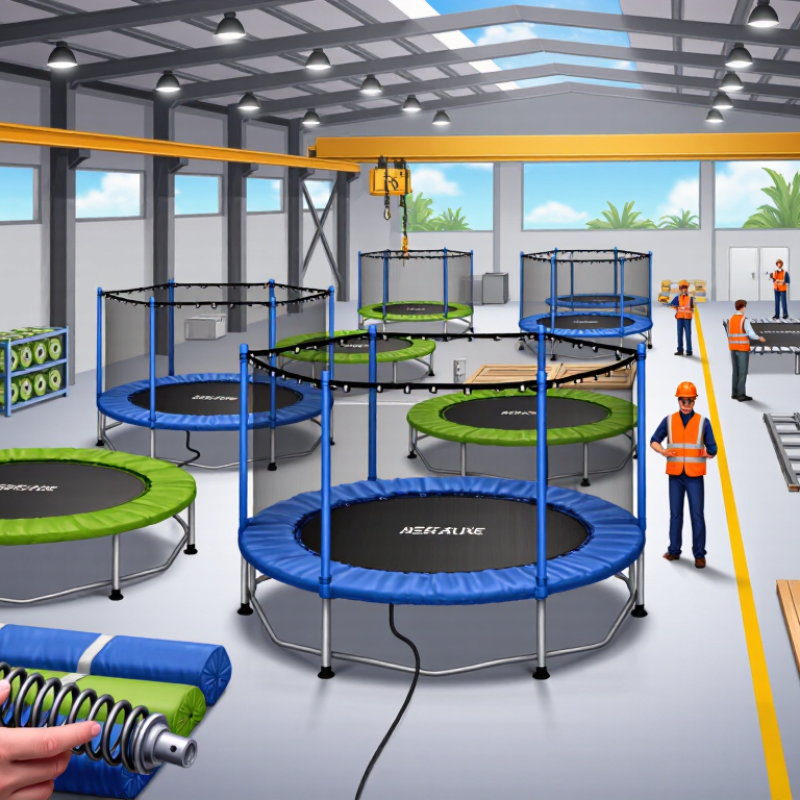
Global Trampoline Manufacturing: Industry Scope and Buyer Requirements
2026 Best Trampoline Manufacturers for Global Buyers
Global trampoline manufacturing now serves homes, schools, indoor parks, fitness centers, and hospitality projects. Each market needs different frame strength, mat dimensions, padding, packaging, and installation support. Experienced buyers should examine the complete production process, not only product photographs. Check steel specifications, welding consistency, spring coating, UV resistance, and foam recovery after repeated compression. Request batch records and recent inspection reports. Reliable manufacturers can explain their testing methods clearly. They should also provide traceable material information and practical replacement-part support.
Tips: Compare samples from several factories. Measure frame joints, inspect stitching, and test padding edges by hand. Ask for load-test data under realistic conditions. Confirm packaging details, container efficiency, assembly instructions, and communication procedures. Requirements differ between countries, so buyers should verify applicable safety standards with qualified local professionals. A polished certificate alone proves little.
A factory audit can reveal details that online conversations hide, such as crowded workstations or inconsistent final checks. Still, no supplier is flawless. Small packaging damage may occur, and delivery estimates can change during peak seasons. The important issue is how the manufacturer responds. Does the team investigate root causes and document corrective action? Buyers should define acceptance criteria before ordering, including color tolerance, component counts, labeling, and defect limits. Careful records reduce disputes, although they cannot remove every risk.
| Evaluation Dimension | Industry Scope | Typical Technical Benchmark | Global Buyer Requirement | Recommended Verification Evidence |
|---|---|---|---|---|
| Product Categories | Domestic round, oval, rectangular, and square trampolines; in-ground systems; compact indoor models; fitness trampolines; and commercial recreation units. | Product selection should be matched to intended use, user age, installation environment, and maximum user weight. | Require a clearly defined product family, intended-use statement, installation instructions, and maximum user weight for every SKU. | Product specification sheet, user manual, dimensional drawing, packaging artwork, and product photographs. |
| Primary Export Markets | North America, the European Economic Area, the United Kingdom, Australia, New Zealand, the Middle East, and selected Asian markets. | Applicable requirements vary by destination market, sales channel, product classification, and whether the product is for domestic or commercial use. | Confirm the destination country before production and identify all mandatory labeling, language, testing, and importer obligations. | Market-specific compliance matrix, destination-language labels, technical file index, and pre-shipment checklist. |
| Safety Standards | Domestic products commonly require assessment against relevant consumer-product and toy-safety requirements. Commercial gymnastic equipment may fall under different standards. | Commonly referenced standards include ASTM F381, ASTM F2225, ASTM F2774, EN 71-14, and EN 13219, subject to product scope and market applicability. | The manufacturer must identify the exact edition and applicability of each standard instead of using a generic “CE” or “ASTM approved” statement. | Accredited laboratory reports, standard-to-test-item matrix, declaration of conformity where applicable, and technical construction file. |
| Frame Construction | Galvanized or powder-coated steel frames are widely used for outdoor domestic trampolines; premium designs may use enhanced corrosion-protection systems. | Typical buyer specifications include welded or mechanically secured joints, stable leg geometry, protected edges, and outdoor corrosion resistance. | Require material grade, tube dimensions, coating specification, weld-quality controls, load testing, and inspection of sharp edges and pinch points. | Material certificates, welding inspection records, coating test results, dimensional inspection report, and production photographs. |
| Jumping Mat | The mat is normally manufactured from woven polypropylene or comparable synthetic webbing with reinforced attachment points. | Key factors include weave consistency, UV resistance, seam or edge reinforcement, hook or V-ring security, and controlled mat tension. | Specify mat material, weave construction, attachment method, UV-aging expectation, colorfastness, and maximum user load. | Material declaration, tensile or attachment-strength test, UV-resistance test where required, and incoming-material inspection records. |
| Spring System | Conventional steel coil springs remain common; springless systems use composite rods or flexible structural elements. | Spring length, wire diameter, end-hook design, corrosion protection, fatigue performance, and consistent spring count are critical. | Require fatigue testing, spring-load consistency, corrosion protection, secure attachment, and safe removal or replacement procedures. | Spring material certificate, fatigue-cycle test, dimensional sampling report, corrosion test, and assembly-line checklist. |
| Safety Enclosure | Safety nets may be installed inside or outside the frame and are generally supported by flexible or rigid poles with padded covers. | Typical requirements address net strength, opening size, pole stability, entry closure, padding coverage, and prevention of contact with hard components. | Specify mesh construction, pole diameter, padding thickness, zipper or overlap design, attachment points, and replacement-part availability. | Enclosure-impact test, net tensile test, pole-bend or stability test, padding material report, and assembly instructions. |
| Padding and Impact Protection | Frame pads are generally made from closed-cell or resilient foam with a weather-resistant PVC, PE, or equivalent cover. | Coverage should protect the frame and springs in the intended user area; seams, fastening points, and drainage should withstand outdoor use. | Require padding dimensions, foam density or performance data, cover thickness, UV and water-resistance expectations, and secure fastening. | Foam and cover material reports, impact or compression testing, seam inspection, water-resistance evidence, and production samples. |
| Corrosion Protection | Outdoor trampolines are exposed to rain, humidity, salt air, temperature changes, and ultraviolet radiation during their service life. | Common protection methods include hot-dip galvanizing, electro-galvanizing, powder coating, e-coating, or combined systems. | Select the protection system according to climate and installation location; coastal and high-humidity projects need stricter controls. | Coating thickness records, salt-spray or equivalent corrosion testing where specified, surface-treatment process records, and visual inspection. |
| Load and Stability | Stability depends on frame geometry, leg design, anchoring, wind exposure, user load, and installation surface. | A complete evaluation should cover static load, repeated loading, frame deformation, tipping resistance, anchor performance, and installation tolerances. | Require a stated maximum user weight, single-user policy where applicable, anchoring instructions, wind-related installation guidance, and test conditions. | Load-test report, stability assessment, anchor test, engineering calculations, installation manual, and field-use warning labels. |
| Manufacturing Quality System | Reliable production normally includes incoming inspection, controlled welding and coating processes, assembly checks, functional testing, and final inspection. | A documented quality system should provide traceability from raw materials to finished cartons and replacement parts. | Require inspection plans, defect classification, corrective-action records, batch traceability, calibration control, and retention of test samples. | ISO 9001 certification when available, quality manual, inspection standard, calibration records, CAPA records, and batch code format. |
| Factory Capacity | Capacity is influenced by steel processing, spring and mat sourcing, sewing, coating, assembly, packaging, testing, and seasonal demand. | Capacity should be evaluated by confirmed monthly output for the specific model, not by total factory output across unrelated products. | Request production lead time, peak-season capacity, minimum order quantity, tooling status, component bottlenecks, and contingency planning. | Capacity statement, production schedule, line photographs or audit report, component supplier plan, and historical on-time delivery data. |
| Customization Capability | Common customization includes dimensions, frame finish, mat artwork, pad colors, enclosure design, carton graphics, manuals, and bundled accessories. | Engineering changes should be controlled through drawings, approved samples, revision numbers, and formal change authorization. | Confirm prototype fees, mold or tooling ownership, artwork requirements, sample approval process, and change-control responsibilities. | Approved golden sample, engineering drawing, bill of materials, artwork proof, revision history, and pre-production approval record. |
| Packaging and Logistics | Trampolines are frequently shipped in flat-packed cartons or multiple cartons containing the frame, mat, springs, enclosure, hardware, and instructions. | Packaging should prevent frame deformation, coating damage, missing hardware, moisture intrusion, and carton collapse during multimodal transport. | Require carton dimensions, gross and net weight, palletization plan, drop or compression testing where appropriate, barcode, and spare-hardware policy. | Packaging specification, carton drop-test record, container loading plan, packing list, barcode proof, and shipping damage analysis. |
| Documentation and Labeling | Safety documentation commonly includes assembly instructions, operating rules, warnings, maintenance guidance, parts diagrams, and disposal information. | Instructions should be destination-language appropriate, legible, durable, and consistent with the tested product configuration. | Require approved manuals and labels before mass production, including maximum user weight, supervision guidance, installation warnings, and inspection intervals. | Final manual PDF, label artwork, translation review, warning-label durability evidence, spare-parts diagram, and revision-controlled document list. |
| After-Sales Support | Long-term support typically covers nets, mats, springs, pads, poles, anchors, hardware, warranty claims, and assembly assistance. | Replacement parts should be identifiable by model and revision, with consistent dimensions and compatibility information. | Define warranty period, claim evidence, response time, spare-parts availability, service contact, and responsibility for field corrective actions. | Warranty policy, spare-parts list, service-level agreement, claim form, parts compatibility chart, and complaint trend report. |
| Sustainability and Materials | Buyers increasingly assess packaging reduction, restricted substances, recycled content, product repairability, and end-of-life separation. | The main material streams are steel, synthetic textiles, polymer padding, plastic components, inks, adhesives, and packaging board. | Request material declarations, restricted-substance compliance, packaging composition, recycled-content claims, and responsible disposal guidance. | Supplier declarations, laboratory chemical reports where required, packaging material breakdown, recycled-content evidence, and environmental policy. |
| Commercial and Public-Use Projects | Commercial recreation centers, hotels, schools, camps, and public facilities generally require more intensive risk assessment and maintenance control than domestic use. | Project evaluation should consider higher usage frequency, supervision, anchoring, inspection intervals, user flow, site conditions, and local regulations. | Require site-specific engineering review, documented installation, operator training, maintenance schedules, incident procedures, and inspection logs. | Site risk assessment, installation acceptance report, operator manual, maintenance log template, training record, and third-party inspection where required. |
| Buyer Due Diligence | Manufacturer selection should combine technical compliance, quality consistency, commercial reliability, ethical sourcing, and total landed cost. | A balanced assessment should cover product safety, factory capability, quality history, delivery performance, documentation, and service support. | Use a weighted supplier scorecard and approve production only after sample validation, compliance review, factory audit, and pre-shipment inspection. | Supplier questionnaire, factory-audit report, sample evaluation form, test-report verification, purchase contract, and inspection release record. |