

7 Best Louvered Roof Gazebos for Outdoor Living
Outdoor living is no longer limited to a table, grill, and a few folding chairs. Homeowners increasingly want flexible spaces that feel comfortable in changing weather. The National Kitchen & Bath Association’s 2024 Outdoor Living Report highlights growing interest in shaded seating, integrated cooking areas, lighting, and durable outdoor finishes. These features closely match the practical benefits of a Louvered Roof Gazebo.
Market research also supports this shift. Grand View Research identifies outdoor living products as a growing residential improvement category, driven by entertaining, home personalization, and year-round usability. However, market growth does not make every gazebo a smart purchase. Roof construction, drainage, motor quality, wind resistance, maintenance access, and installation requirements still demand careful review.
Small details matter.
A well-designed louvered roof can angle sunlight away from a dining table while allowing ventilation through warm afternoon air. In heavy rain, properly connected gutters should move water toward planned drainage points, not onto a patio doorway. Product testing and manufacturer documentation deserve more attention than attractive photographs. Some models look impressive online but provide limited information about aluminum thickness, load ratings, or replacement parts.
This guide reviews seven of the best Louvered Roof Gazebo options for outdoor living. The comparison considers design, materials, weather control, usability, installation complexity, and long-term value. It also acknowledges an uncomfortable truth: no single model suits every yard, climate, or budget. A careful choice begins with measurements, local weather patterns, and realistic expectations.
What Is a Louvered Roof Gazebo?
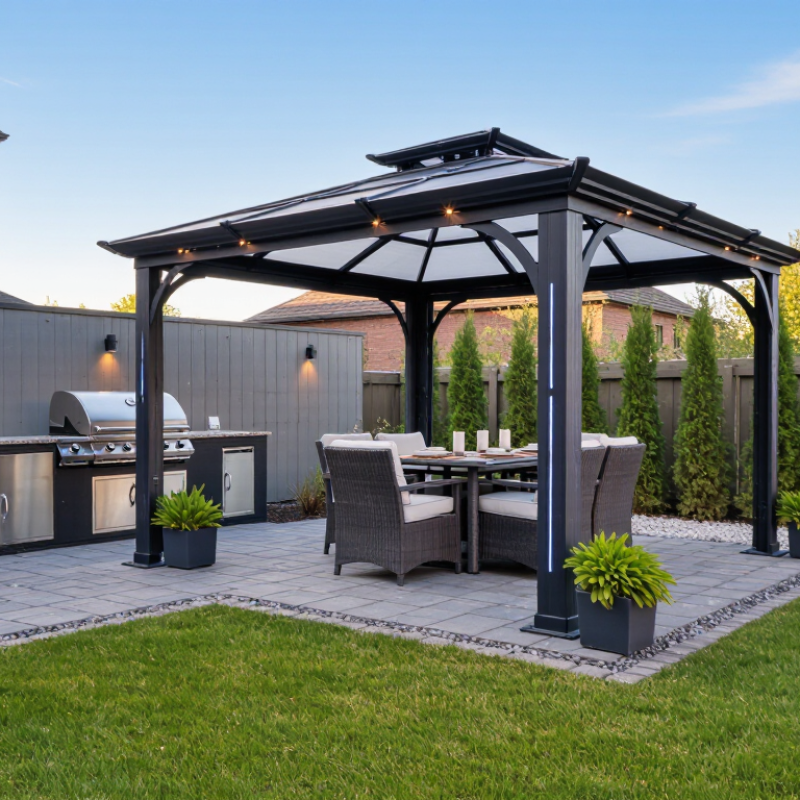
A louvered roof gazebo is an outdoor shelter with adjustable slats instead of a fixed roof. The slats rotate to control sunlight, airflow, and light rain. Open them on bright mornings. Close them when showers begin. Unlike a fabric canopy, this structure uses a framed roof, posts, and often integrated gutters. Some models use a hand crank, while others use a motor and remote control.
In daily use, the roof changes patio comfort surprisingly quickly. At noon, angled slats can shade a dining table without blocking every breeze. During light rain, closed slats guide water toward channels and down the posts. That detail matters more than glossy pictures suggest. A roof is not automatically storm-proof. Strong wind, heavy snow, or standing water can damage poorly installed systems. Check local weather, anchoring requirements, drainage paths, and load ratings before installation.
Good planning also includes the roof’s direction and nearby trees. Falling leaves can clog gutters, while low winter sun may require a different slat angle. Aluminum frames resist rust, but finishes still need gentle cleaning and inspection. I would leave room around moving parts. That small oversight is easy to make. Professional installation is sensible when the surface is uneven or electrical wiring is involved. A louvered roof gazebo works best as a flexible outdoor room, not an all-weather building.
7 Best Louvered Roof Gazebos for Outdoor Living - What Is a Louvered Roof Gazebo?
A louvered roof gazebo is an outdoor structure with adjustable slats that can be tilted to control sunlight, airflow, and light rain. The specifications below represent common residential configurations; exact performance varies by construction and installation quality.
| Configuration | Typical Footprint | Louver Operation | Common Roof Material | Best Use | Main Advantages | Important Consideration |
|---|---|---|---|---|---|---|
| 1. Compact Freestanding Gazebo | 10 × 10 ft (3.05 × 3.05 m) | Manual crank or basic motorized adjustment | Powder-coated aluminum slats | Small patios, balconies, and two-to-four-person seating areas | Efficient use of space; generally simpler to install; lower material requirement | Limited room for large dining sets or extensive outdoor furniture |
| 2. Balanced Patio Gazebo | 10 × 12 ft (3.05 × 3.66 m) | Manual or motorized louvers, commonly adjustable through a wide opening range | Aluminum louvers with integrated rain channels | Everyday dining, lounging, and compact grilling zones | Good balance between floor area, shade, and installation footprint | Requires a level, stable base and adequate clearance around the structure |
| 3. Family-Size Freestanding Gazebo | 12 × 12 ft (3.66 × 3.66 m) | Motorized or manual adjustment, depending on configuration | Coated aluminum slats and aluminum frame | Family seating, outdoor meals, and flexible entertaining | Comfortable square layout; accommodates furniture while retaining open circulation | Larger roof area can increase wind exposure and anchoring requirements |
| 4. Extended Dining Gazebo | 12 × 16 ft (3.66 × 4.88 m) | Motorized louvers are useful for frequent sun and rain adjustments | Aluminum louvers with concealed or integrated drainage | Six-to-eight-person dining, outdoor kitchens, and long seating arrangements | Long rectangular footprint separates dining, cooking, and lounging areas | Needs more foundation space and may require additional structural anchoring |
| 5. Large Entertaining Gazebo | 13 × 19 ft (3.96 × 5.79 m) | Typically motorized, with controls for convenient multi-zone use | Reinforced powder-coated aluminum louvers | Large gatherings, outdoor bars, kitchens, and multiple furniture groups | Provides substantial covered living space while allowing adjustable daylight and ventilation | Higher installation cost, greater wind loading, and more demanding site preparation |
| 6. Wall-Mounted Lean-To Gazebo | Commonly 10 × 12 ft (3.05 × 3.66 m) | Manual or motorized, with controls positioned near the attached wall | Aluminum louvers supported by a wall-connected frame | Patios directly outside kitchens, living rooms, or rear doors | Uses an existing wall for support; creates a close connection between indoor and outdoor areas | The attachment wall must be structurally suitable and properly sealed against water intrusion |
| 7. Premium Motorized Gazebo | 12 × 16 ft (3.66 × 4.88 m) or larger | Electric motor, remote control, wall switch, or smart-home integration | Heavy-duty coated aluminum slats with engineered drainage | Frequent outdoor use where convenient climate and sunlight control is important | Easy adjustment; can support lighting, screens, heaters, and other compatible accessories | Needs a nearby power source, weather-protected electrical connections, and regular motor maintenance |
Selection note: Check local planning rules, snow and wind requirements, foundation conditions, drainage design, and electrical regulations before installation. Adjustable louvers provide shade and ventilation, but they do not automatically make a gazebo fully weatherproof or suitable for severe storms.